
Just Launched: Scrum Better with Kanban
In this industry pioneering course formed by a partnership between Kanban University and Scrum Alliance®, learn to apply Kanban principles to improve the efficiency and effectiveness of your Scrum!
Trainer Steve Church explains at a high level why Scrum and Kanban work best together:
“When Scrum teams plateau – delivering work but struggling to improve – Kanban can offer a valuable antidote. By introducing Kanban principles and practices, teams gain visibility into workflow, bottlenecks, and delivery times. This transparency helps identify inefficiencies that Scrum alone may not surface. Kanban’s emphasis on visualisation and limiting work in progress (WIP) encourages focus and flow, reducing context switching and improving delivery. It also supports continuous delivery, allowing teams to release value quicker and more frequently.
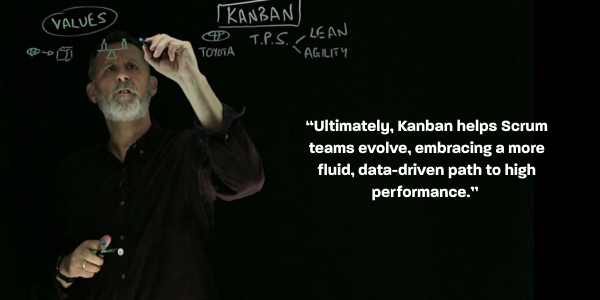
Importantly, Kanban can be layered onto Scrum without disrupting existing roles or events. Teams can still follow the Scrum framework while using Kanban boards to track progress and optimise flow. Kanban can reinvigorate stalled teams, fostering incremental improvement and adaptability. Ultimately, Kanban helps Scrum teams evolve, embracing a more fluid, data-driven path to high performance.”
Quanta’s Lead Agile trainer, Howie Bartrip adds his take with five things adopting Kanban practices can offer to Scrum teams:
1: Improved Flow and Predictability
Scrum provides structure through time-boxed sprints, but it doesn’t inherently optimize flow. That’s where Kanban shines. By visualizing work on a Kanban board and limiting work in progress (WIP), teams can identify bottlenecks early and reduce context switching. This leads to smoother delivery and more predictable outcomes.
Why it matters: Teams can better manage unplanned work, reduce cycle times, and deliver value continuously—even within a sprint-based cadence.
2: Data-Driven Decision Making
Kanban introduces powerful metrics like cycle time, lead time, and throughput. These help Scrum teams move beyond gut-feel estimations and into evidence-based forecasting. Over time, this data enables more accurate sprint planning and stakeholder communication.
Why it matters: You can answer questions like “When will this be done?” with confidence, using historical data instead of guesswork.
3: Greater Transparency and Focus
Kanban’s visual boards make work visible to everyone—team members, stakeholders, and leadership. When combined with Scrum’s daily stand-ups and sprint reviews, this transparency fosters accountability and alignment.
Why it matters: It’s easier to spot blocked items, overloaded team members, or scope creep. Everyone sees the same picture, which improves collaboration and trust.
4: Flexibility for Mixed Work Types
Not all work fits neatly into a two-week sprint. Support tickets, production issues, and research spikes often need faster turnaround. Kanban allows teams to handle this “interrupt-driven” work without derailing their sprint goals.
Why it matters: Scrum teams can maintain focus on sprint commitments while still responding to urgent needs—without burning out or compromising quality.
5: Continuous Improvement Culture
Kanban encourages a mindset of evolutionary change. By regularly reviewing flow metrics and experimenting with WIP limits or policies, teams can fine-tune their process incrementally. This complements Scrum’s inspect-and-adapt philosophy and makes retrospectives more actionable.
Why it matters: You’re not just doing Agile—you’re becoming agile. The team evolves its process based on real-world feedback and performance data.
Final Thoughts
Adding Kanban to Scrum isn’t about replacing one framework with another—it’s about enhancing what already works. Whether your team is struggling with flow, juggling multiple work types, or simply looking to improve delivery, Kanban offers a lightweight, high-impact set of practices that can make Scrum even better.
Ready to take the next step? Consider exploring the Scrum – Better with Kanban certification to equip your team with the tools and mindset needed to thrive in today’s fast-paced delivery environments.”
Learn more about Scrum Better with Kanban here.
Trusted By















Get Started
Forget trawling through endless course catalogues – Find the training that’s right for you
Learn More
Training was excellent, our trainer, Tim Finch, was really knowledgeable and helpful. He tailored the course to suit our needs and could tell that he had a passion for the…- Gareth Davies
The interactive activities were excellent, and really got people thinking about the Agile process.- Richard Mitchell-Williams, NPower Ltd Rainton
Excellent and informative instruction. Pleased to see some intelligent use of the short time frame to use Agile to resolve our questions.- Mark Wilson Ramsay, Jaguar Land Rover (Whitley)
The tutors were superb, and I learnt far more than expected, the way the training was tailored was excellent. It far exceeded my expectations.- Mark Ellison, Jaguar Land Rover (Whitley)
Tim is a fantastic tutor and really brings the content to life. He made us all very relaxed about the next stage of the course.- Isobel Walker, University Of Birmingham
Latest News from Quanta
New Webinar: The AI Turning Point. Are We Ready to Lead?
The AI Turning Point: Are We Ready to Lead? AI is everywhere – this isn’t news. BUT the mass adoption…
Read More
Just Launched: ITIL® AI Governance
Quanta is very excited to be launching the ITIL AI Governance module with our partners at PeopleCert! ITIL AI Governance…
Read More
Service Management State of Play: All talks available to watch now.
Following the recent Service Management State of Play event in collaboration with PeopleCert, we are pleased to share the presentations…
Read More